
For dreamers raised on Hollywood films and science-fiction novels, the future has meant fast hovercraft soaring through the skies. In fiction, humans navigate vast cityscapes, no longer confined by gravity with flight made effortless through technological advancement. Such imaginary worlds have inspired aviation and aerospace leaders to rethink what’s possible.
Advanced Air Mobility (AAM) vehicles—electric and hybrid-electric personal craft and air taxis—represent what could well be a revolution in travel and transportation. These sophisticated, highly maneuverable aircraft may not directly resemble the machines in The Jetsons or Blade Runner, but they are sleek, technologically ambitious efforts to reshape personal, urban and regional travel. A class of aircraft primed to fulfill a role much like the flying cars of science fiction.

Today, companies like Archer Aviation and its Midnight eVTOL “flying taxi” aim to deliver that future into today’s world. In March 2026, the federal government launched a three-year program creating the conditions for leading eVTOL (electric vertical take-off and landing aircraft) developers like Archer Aviation to test their aircraft in more than 26 U.S. states. The goal of this program, the Department of Transportation says, is to assess real world environments for urban air taxi networks. Archer’s Midnight is designed to carry four passengers and one pilot for distances of 20–50 miles before recharging, ultimately connecting major urban centers and regional routes.
Archer and its competitors will use the federal program to test their designs and work toward securing FAA certification, a crucial step for starting commercial operations and developing the necessary infrastructure to support AAM aircraft like eVTOLs. These flying taxis promise connectivity with minimal noise pollution, making them suitable for densely populated spaces with noise restrictions. Additionally, air taxis are being positioned to serve VIPs looking to save time when traveling between regional locations, offering an alternative to private jet travel, chartered helicopters, and luxury car services.

Today, the emerging air taxi and eVTOL market is rife with competition, with companies burning through money while still in the developmental stages. The prospect of a potential transportation revolution has many firms vying for a piece of the action, with some proposing innovative approaches to air taxis and urban air mobility aircraft, including hybrid-electric versions of eVTOLs. Enter PLANA, a company set on developing a hybrid-electric VTOL (vertical take-off and landing) aircraft to rival the purely electric eVTOLs being developed by the larger eVTOL sector.
PLANA’s aircraft will carry six passengers and a pilot on routes of about 350 miles, such as San Jose to Reno or New York to Boston. The hybrid approach is meant to overcome electric-only range limits and address what PLANA Executive Chairman Philippe Bouissou calls “the missing middle.” Specifically, “journeys under roughly 500 miles that today remain stubbornly inefficient—too slow, congested and unreliable on the ground, yet scarce, painful and costly by air,” he said. The goal is to connect areas that are difficult to navigate due to heavy traffic and long car journeys but too inefficient for airplanes or small jets.

Missions will include regional and urban transport that also serve a range of customers, including VIP clientele. Bouissou said PLANA’s aircraft will be ideal for passengers seeking a weekend escape, a resort run, a second-home hop or a same-day business trip. Critically, the aircraft will be quieter than helicopters with their louder noise signatures, making its reduced noise perfect for ferrying passengers to business and event destinations as well as remote properties and private facilities.
Aircraft safety is designed around redundancy, meaning that if one of the powerplants fails, the other engines can continue operating the aircraft. PLANA’s aircraft will also feature advanced flight control software, AI-based systems that predict maintenance needs and mechanisms to ensure aerodynamic stability. “Safety is the foundation of everything we do,” Bouissou said.

PLANA has been testing the aerodynamics and flight control systems of a large sub-scale prototype since 2023, as the company continues to develop its aircraft. “We are not racing for headlines; we are building for real-world deployment,” Bouissou said. He noted that the quieter operations and extended range of PLANA’s aircraft will make a practical difference, as the new aircraft is being designed to use existing flight infrastructure.
“For the luxury and private aviation world, point-to-point access and time reclaimed become a natural extension of what people already value,” Bouissou said. “It’s about redefining what a regional movement can feel like.”

Personal Flight
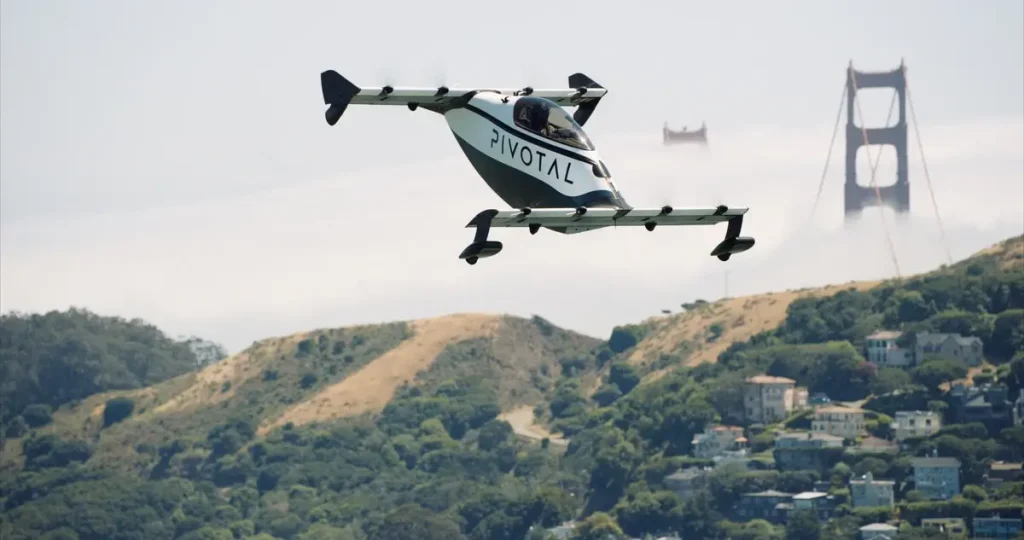
Air taxis could change how groups travel, while the “flying car” targets individual flight. eVTOL technology has already produced personal recreational flying vehicles—a modest label for what is surely an exhilarating experience. Examples ready for early adoption include Jetson’s Jetson One and Pivotal’s Helix. These ultra-light vehicles don’t require a pilot’s license and cost in the low six figures. They can reach about 63 mph while operating hundreds of feet above the ground. Nimble and quick, they resemble flying jet skis and are ideal for weekend flying. Unlike larger air taxis, some ultra-light eVTOLs have been delivered to customers and are already flying.
Companies like London-based AltoVolo are aiming to build a hybrid-electric VTOL aircraft closer to the classic flying car concept. AltoVolo’s Sigma will have a 500-mile range, a cruise speed near 220 mph, and seating for three. The company says Sigma will be about 80 percent quieter than helicopters, making it suitable for residential areas. Its flight ceiling will be around 10,000 feet, a height close to current helicopter altitudes. Moreover, safety is a core design focus, with thrust vectoring stability built into Sigma’s open-rotor design as well as a ballistic parachute ready to deploy in the event of an emergency.

AltoVolo founder and CEO William Wood told Jetset the Sigma uses advanced technology to give customers “the luxury of time” through a versatile aircraft. He likens the interior to a hypercar from elite luxury brands; the cockpit emphasizes ergonomics, styling, and functionality, with flight directed by a three-axis joystick placed near the center of gravity for intuitive control. AltoVolo plans Light Sport Aircraft (LSA) certification, separate certification for potential commercial use and simulator-based owner training. The company lists a “launch edition” for Q1 2029 with a price around £860,000.
“The Sigma fulfills that dream we’ve all had of being able to fly,” Wood said. “Not on an airliner, but actually to fly ourselves.”