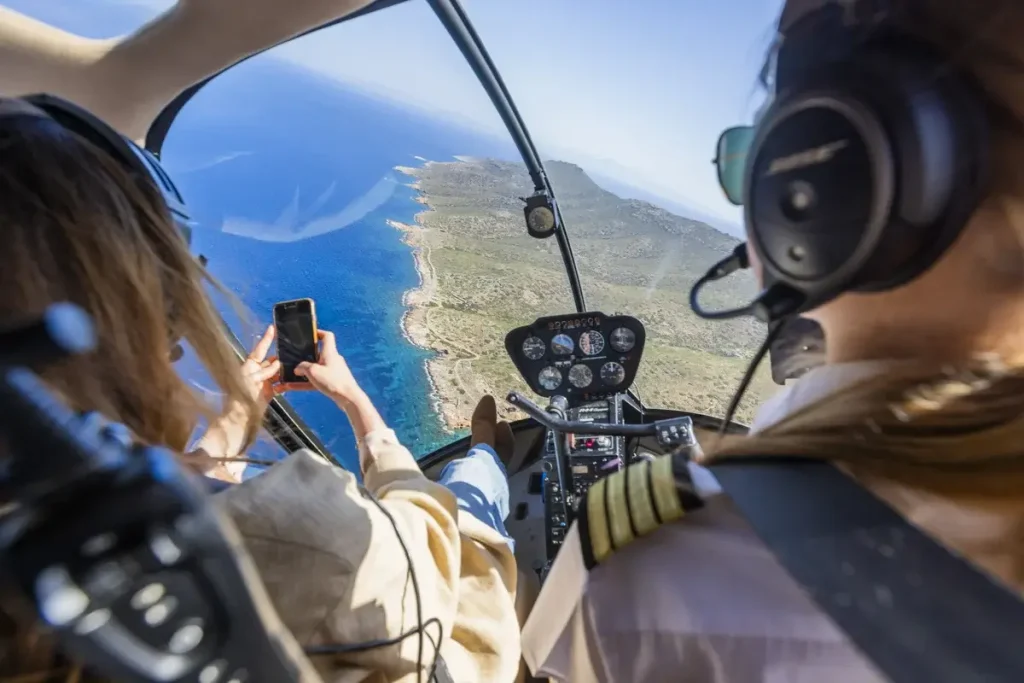

When hoper launched in the Greek isles in 2024, their mission was clear: make helicopter travel more accessible between the islands. As they continue to grow, they have expanded their business platform to now include France, Italy, Switzerland, and the United States.
hoper’s online marketplace for “vertical mobility” connects vetted operators with travelers seeking either shared flights or private charters.
“On certain routes where there are predictable transfer patterns, we layer in a shared seat structure that makes helicopter travel bookable in the same way you’d book an airline ticket,” said Demitris Memos, hoper’s CEO and founder. “It works in Greece because the geography is perfect for it: short distances between islands, high seasonal demand, and genuinely poor alternatives. A four-hour ferry becomes a 35-minute flight.”
Memos says launching an American platform comes with different challenges, but their business model hasn’t changed. “What changes is the use case,” he said. “In Greece, we’re solving an island connectivity problem. In the U.S., the opportunity is shaped by urban congestion and high-value leisure corridors—think JFK to Manhattan, or New York to the Hamptons. The underlying mission though is identical: help people reclaim their time by making vertical mobility accessible.”
Offering cost savings to the consumer while also helping travelers reclaim lost time due to travel delays has always been at the forefront of hoper’s business plan. “Accessibility is our core mission: making helicopter travel bookable and available at scale, for the first time,” Memos said. “Affordability is what makes that accessibility real. We are positioning travel with hoper as a practical, everyday choice, not a luxury reserved for the few.”
With seats costing as low as $130 for a shared flight, hoper works much like a micro-airline with cost savings passed onto the traveler. “By aggregating demand across multiple passengers on the same route, we’re able to distribute the cost of the aircraft across seats,” Memos said. “That’s what unlocks the price point. We also benefit from route density. The more routes and destinations we add to the network, the more efficiently we can schedule and operate.”

After viewing routes, timings, and pricing, travelers complete a booking under the single global platform. “From there, we handle pre-flight communication, coordination with hotels or ground transport, and the journey itself,” he said.
When asked which age group hoper is targeting, Memos said they focus more on why they are traveling rather than who is traveling. “What unites them is a shared set of values: they value their time; they appreciate well-designed experiences and they’re open to rethinking how they travel,” he said. “That cuts across generations entirely. Whether it’s a couple island-hopping in Greece or someone heading out to the Hamptons for the weekend, the common thread is a preference for efficiency and experience.”
hoper’s shared seat model has also expanded the way consumers view helicopter travel. For those who may have considered it reserved exclusively for high-net worth travelers, hoper’s affordability has proven to be a game changer.
“That’s naturally drawing in a broader and younger audience, and we see that shift accelerating as the network grows and awareness builds,” Memos said. “2026 is a significant year for us across several fronts. In Greece, we’ve expanded our shared flight network to 15 destinations and more than 50 routes. We’re launching into Italy with private flights operating from Cannes, Nice and Monaco to Milan, Florence, Portofino and Turin.”

Within the United States, hoper operates helicopter sightseeing in Los Angeles and is planning to introduce full operations out of New York, including both private flights and shared flight service between JFK and Manhattan in September, timed around the U.S. Open Tennis Championships.
Memos says hoper’s expansion strategy focuses on regions where geography and congestion make traditional transport genuinely inefficient, and where a strong culture of premium travel is already in place. “In Greece, island geography made the case obvious,” he said. “Connections that would take hours by ferry take under 45 minutes by air. In the south of France, it’s the combination of luxury leisure corridors and congested coastal roads. In the US, it is dense urban demand paired with high-value leisure destinations with New York to the Hamptons being a clear example. We’re looking for places where the time saving is most tangible and immediate.”
In recent years, helicopter travel has gained popularity in the United States as travelers seek options for faster transit. “America already has a strong appetite for premium, time-efficient travel,” Memos noted. “People instinctively understand the value of reclaiming time, especially in corridors like New York where ground transport has become increasingly unpredictable.

Awareness of vertical mobility is growing fast, and legislation is catching up. The U.S. Congress introduced the Aviation Innovation and Global Competitiveness Act in February 2026, specifically to accelerate FAA certification of eVTOLs (electric Vertical Takeoff and Landing aircraft), bringing vertical mobility into mainstream conversation.”
Memos believes America has also ideally positioned itself as the home where the next generation of aircraft is being built. “Many of the eVTOL companies that will define the future of short-haul aerial travel are American, and that concentration of innovation is creating an ecosystem of investment, infrastructure, and public awareness,” he said. “We expect passengers to be traveling in flying taxis by 2028 to 2030, and we’re laying the groundwork for that now. What hoper is doing today is bridging the gap between today’s helicopters and tomorrow’s electric aircraft. By the time eVTOLs are certified and ready to scale, the behavior will already be there. And we intend to be the platform that carries it forward.”